

Many people arrive in Sicily without realizing that they are carrying Northern European reflexes with them. Expectations shaped by efficiency, structure, and control quietly travel in their luggage.
But Sicily asks for something different: less control, less urgency, and a willingness to experience life through time, simplicity, and human connection. This is where its silent luxury begins.
I have been living for nearly nine years on the island of Ortigia, in the city of Siracusa—an island within an island. Sometimes I think of it like a matryoshka doll: layered, inward-looking, and deeply self-contained. Ortigia lives by its own rhythm, its own rules, beliefs, tastes, and scents. And in many ways, so does all of Sicily.
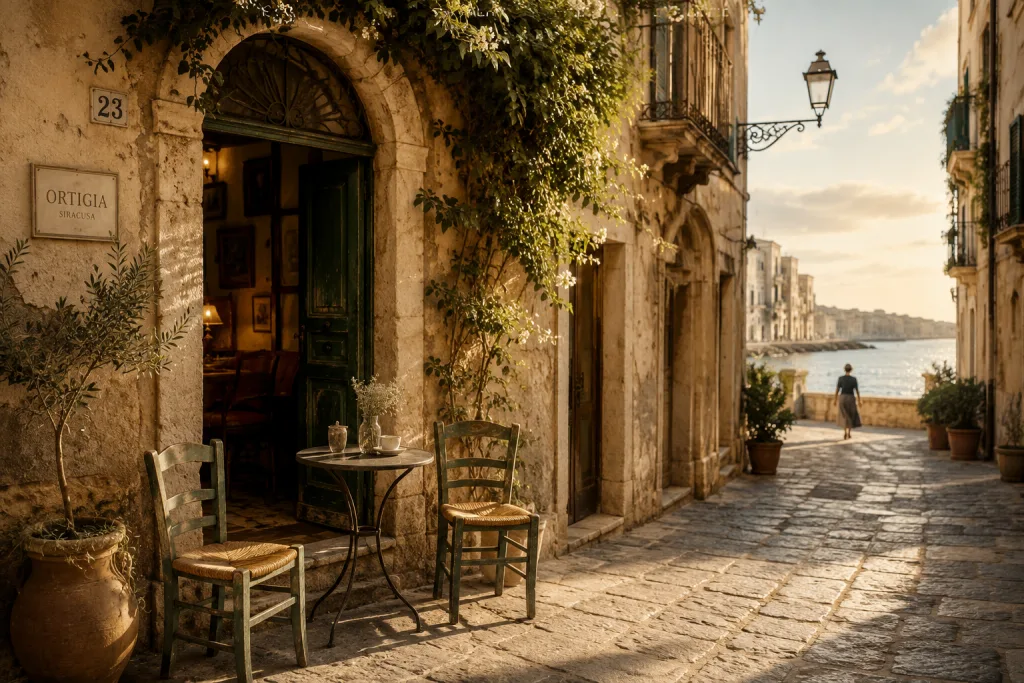
Silent Luxury in Sicily
This is why Sicily is not “Italy” in the way many people imagine it. And it certainly isn’t anything like Northern Europe.
The reasons for this go deep—history, governance, and the many civilizations that have passed through the island. But more than anything else, Sicily has remained profoundly human.
Everything that makes a human life—its contradictions, its imperfections, its light and shadow—still exists here. And perhaps that is why, no matter where you come from, Sicily allows you to recognize something essential within yourself in a way that feels unusually clear and unfiltered.Inner Sicily: Palazzolo Acreide & Buscemi Experience
Here, the distractions of luxury, materialism, and excess that dominate much of Northern Italy or Northern Europe fade into the background.
What remains is simplicity.
And it is precisely this simplicity that becomes a form of silent luxury.
Maybe what many of us are searching for—calm, presence, and the ability to stay connected to ourselves—has been here all along.
This is Sicily.
Silent Luxury Begins with a Different Sense of Time
During the years I lived in the Netherlands, a dear friend of mine—someone shaped by the warmth, slowness, and sweetness of southern cultures—once said something I never forgot:
“We don’t have clocks. We have time.”
That sentence explains Sicily better than any guidebook ever could.
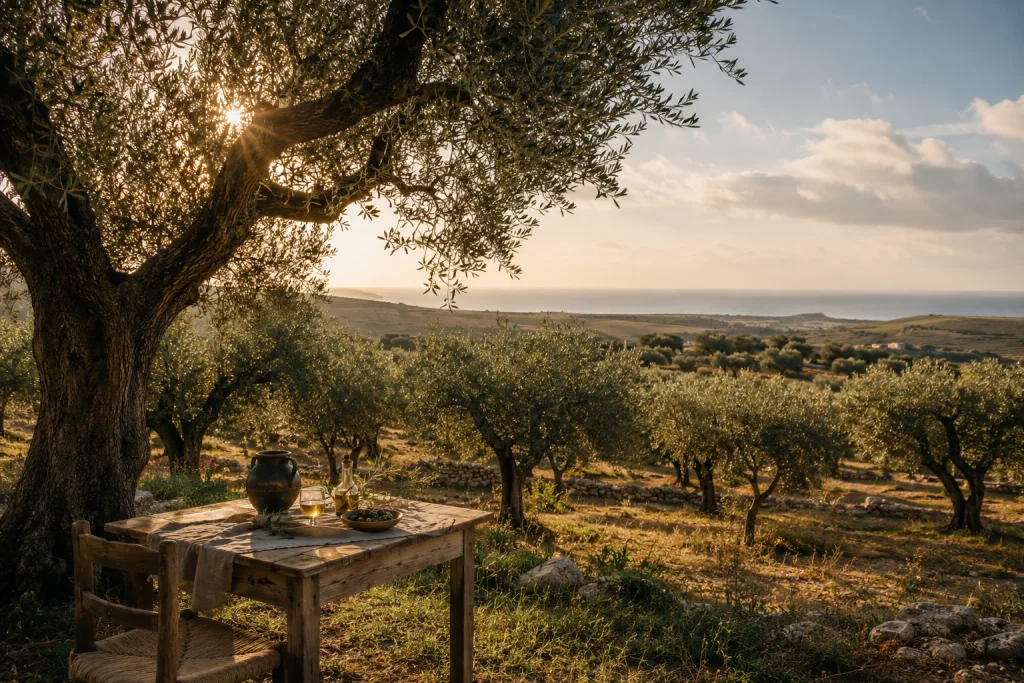
In Sicily, the concept of time doesn’t revolve around the clock. It moves with time itself. Or perhaps even before the clock, with the sun—its rhythm, its intensity, its demands.
This is a warm land, and the climate itself requires life to slow down. And because of that, people here are deeply patient.
You see it everywhere.
Two people meet on the street, greet each other, and suddenly stop. Not for a minute or two—but for twenty, thirty minutes, as if they haven’t seen each other in ten years.
If you try to pass them quickly on the sidewalk and can’t immediately find the right Italian words—even if you know how to say scusi—they may not notice you at all.
Not out of rudeness, but because they are fully present.
Completely absorbed in the moment, in the conversation, in the person in front of them.
It almost feels like mindfulness. And yet, if you asked most Sicilians what “mindfulness” means, many wouldn’t know the word.
They don’t need to name it.
They live it—through slowness, silence, and attention.
That’s why, in Sicily, it makes more sense to ask, “Do you have time?” rather than “What time is it?”
And when you ask that question, you will rarely hear a clear “no.”
Not because people are avoiding commitment, but because time here is fluid. The answer is often we’ll see, soon, or we’ll do it.
Of course, when it comes to doctors, lawyers, or important appointments, schedules do exist. But even then, if you arrive late and casually explain that there was traffic, no one scolds you or charges you extra. Even cancellations are often met with a smile.
This is Sicily’s waiting culture.
Lunch breaks are sacred. Shops close around one or one-thirty and reopen around four-thirty or five.
For many visitors—especially those who join my experiences—the first question is always the same:
Are shops open all day? When do they close?
What they don’t yet know is that lunchtime is often the most beautiful moment of the day.
Meals at home.
Food prepared by a grandmother.Gastro Producers & Table Culture Experience
Vegetables from the garden.
And afterward, that sweet midday rest—especially in summer—when the sun demands stillness.
Meanwhile, the streets and squares, under the strongest sun, are filled almost exclusively with tourists.
Locals are elsewhere—eating, resting, living.
And honestly, it’s quite amusing to watch.
Perhaps this is one of the first lessons in silent luxury: not every hour needs to be filled, optimized, or used.
Some hours are simply meant to be lived.
Don’t Confuse Efficiency with Quality: In Sicily, Speed Is Never the Measure
In Sicily, slowness is not a flaw—it is a value.
Speed has never been synonymous with quality here. Things done in a hurry are rarely considered good; more often, they are considered incomplete.
We all recognize those ideas we admire but struggle to live by.
We read them in books, see them on Instagram, sigh quietly, save the post, and think:
Maybe one day this will help me.
Maybe one day I’ll apply it.
In Sicily, however, these ideas are not theory.
They are daily practice.
Here, efficiency is measured not by how fast something is done, but by how much care and effort it carries.
In the past, when people didn’t have access to what they needed, they created it themselves. Perhaps this is why so many professions—some we can no longer even name—were born on this island.
The contribution of artisans to everyday life is undeniable.Ortigia Slow Living & Local Rituals Experience
Craft here is not merely production; it is a way of being.
Even today, in some of Sicily’s hidden towns, you can still witness this culture. There are small, interactive museums dedicated to traditional professions, showing how artisan families once wove work and daily life together.
Walking through these spaces feels like stepping into another time, prompting a simple but powerful thought:
Did people really live like this?
Perhaps this is what makes Sicily so unique.
Here, what is truly good is not defined by speed, but by the quiet, human feeling that slowness allows to emerge.
This, too, is silent luxury.
Not perfection.
Not instant results.
But the time, patience, and human touch behind what is made.
Don’t Expect Service—Expect Relationships
In Sicily, relationships are life itself.
They are like flowers, bread, water, and air—essential, nourishing, and deeply human.
In Northern Europe, or in many other countries—especially when we travel—we tend to expect service rather than connection.
Luxury hotels.
Flawless efficiency.
Perfect English.
Attention to detail.
If we spend money, we expect something in return.
That makes sense.
But in doing so, we often forget the most important thing:
What cannot be bought.
What cannot be touched.
What only reaches you through the heart.
Relationships.
This is where Sicily begins.
I remember my very first visit to Sicily, about ten years ago, in Ortigia.
I stopped in front of a tiny workshop with its door wide open. Inside, an elderly man was working among pieces of wood.
I leaned in and noticed a small hand-carved wooden swallow—so small it fit in the palm of my hand. It wasn’t a souvenir, not even a magnet.
Just a small object.
I asked the price.
“Two euros,” he said.
I didn’t have two euros. Not even five. Only a large banknote.
“No problem,” he said. “You can bring it later.”
“Later?” I asked. “I don’t live here.”
“No problem,” he said again.
That was the moment I understood:
This was a different place.
I remember thinking that something like this would never have been possible where I was living at the time.
In Sicily, moments like this happen often.
And perhaps when you leave the island, one of your most unforgettable memories will be something just like this.
When it comes to relationships, everything else stops here.
Especially on an island, human connection carries a different weight.
Even in the simplest daily rituals—walking to your local café in the morning—you are greeted along the way.
Smiles.
Greetings.
Eye contact.
These small gestures nourish the human psyche.
They make you feel rich.
Sometimes I notice my posture changing as I walk. My coat feels more elegant. My clothes seem to fit me better.
Because someone sees you.
As a person.
In big cities, we are often surrounded by people who look at us but do not truly see us.
In Sicily, that changes.
Here, relationships feed you.
They sustain you.
And they have no price.
Perhaps this is the deepest form of silent luxury Sicily has to offer: the feeling of being seen, remembered, and welcomed.
Sicily Is Not Visited. You Adapt to It.
Sicily is not a checklist of places to see.
It is a rhythm.
The more you adapt, the more it opens.
Here, it’s not about seeing more.
It’s about finding your place.
Sicily opens through trust, not control.
Plans may change.
Time may shift.
But when you let go, Sicily begins to tell its own story.
The most beautiful moments are often the unplanned ones.
A conversation you never expected.
A door left open.
A person who invites you in.
A lunch that lasts longer than planned.
A place you had never heard of.
A moment that was never on your itinerary.
Not Touring Sicily, but Feeling It
Slow down instead of speeding up.
Listen.
Wait.
Observe.
Sicily reveals itself not to those who rush, but to those who feel.
A coffee.
A greeting.
A conversation.
Someone remembering your name.
Someone telling you, “You can pay me later.”
These may seem like small things.
But perhaps the things that change us most are always small.
The Meaning of Silent Luxury in Sicily
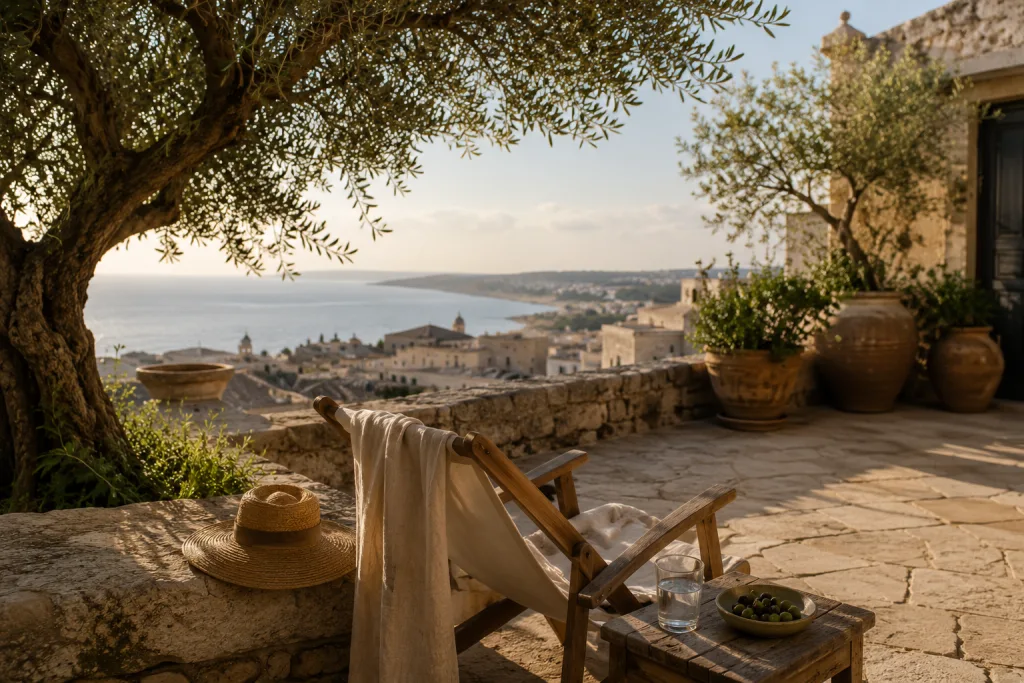
No display.
No excess.
No need to prove anything.
Just simplicity, time, and human connection.
This is the meaning of silent luxury in Sicily.
It is not about how much you can buy, how many places you can see, or how perfectly your journey follows a plan.
It is about how deeply you can experience a place.
Sicily doesn’t tell you what to do.
It asks you to slow down, let go, and trust.
Because here, the most beautiful things are often found not through planning, but through feeling.
And when you truly live Sicily—not just see it—it quietly changes you too.